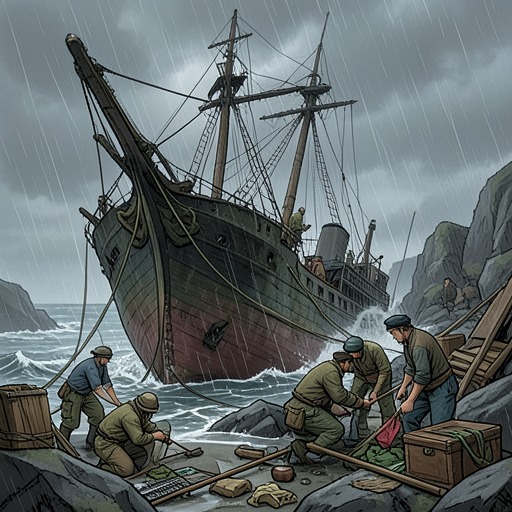
The Endeavor's Wrecked Condition
Chasing SunlightThe Endeavor's Wrecked Condition is the ship’s pre-refit state: a vessel so severely damaged that Captain Montgomery initially regards it as an implausible basis for another venture, yet one whose surviving structure and legal identity allow Jonathan Heights to restore it. Its wreckage gives the expedition a practical urgency and a thematic shape, turning repair into a condition of exploration in a world where survival depends on making damaged things serve again.
Damage and Initial Assessment
The Endeavor is described as more scrap than ship when Jonathan Heights considers Captain Montgomery’s objections. The vessel is partly melted and partly dissolved; its envelope is mostly burned away, while portions of the superstructure are crazed with cracks caused by luminiferous detonation. The damage is not cosmetic and does not merely mark an old vessel as weathered. It threatens the airship’s basic integrity, making the planned venture appear reckless by ordinary standards.
The wreck also carries a history of failed survival. Captain Montgomery has managed to bring the damaged vessel back into port, and that achievement becomes the first of Jonathan Heights’s three reasons for selecting him. Montgomery’s long experience and excellent reputation matter, but Jonathan also bluntly identifies the captain’s desperation as an asset. The Endeavor’s condition therefore links the ship and its commander: both are experienced, compromised, and pressed into a venture because conventional prospects have narrowed.
The Refitting Logic
The crucial distinction is that the ship is damaged rather than wholly lost. At Crowley, Stanford, and Moore, the Endeavor floats on the lowest pylon while the drydock is crowded with cranes, carisium stock, and canvas-covered crates. Much of the vessel has been mangled, but the envelope superstructure, main beam, figurehead, and commissioning plaque have survived. Those remnants make the work a repair instead of the construction of a new ship.
That classification has practical and psychological consequences. A brand-new ship would be considered suitable only by fools or madmen for a voyage into the dark wilds, whereas a repaired veteran vessel can carry the authority of prior service. The surviving commissioning plaque is especially important because it preserves the Endeavor’s continuity as the same ship, even when its material body has been extensively replaced or restored. The refit thus depends on an institutional identity that outlasts physical damage.
Jonathan Heights underwrites the enormous cost of the reconstruction and insists on remaining involved despite the inconvenience this causes the engineers. The decks are only half-completed and not yet fit for habitation when he visits, but he has already studied the specifications from the blueprints. The presence of cranes, stored materials, and unfinished structure makes the ship’s recovery visible as an industrial process rather than a miraculous return to service. The venerable engineering firm of Crowley, Stanford, and Moore must tolerate his supervision because he is financing the work.
From Wreck to Working Vessel
The restored Endeavor is still associated with danger even after months of preparation. Eleanor McAvey investigates the ship and helps frustrate several further sabotage attempts, including the discovery of small glass devices placed in the zint tanks. Other attempts appear to arise from jealousy or from hostility toward Crowley, Stanford, and Moore, but no decisive culprit is identified. The absence of a second appearance by the person responsible for the glass devices leaves Jonathan Heights worried that some threat has escaped detection.
By the time Jonathan Heights travels toward the Port Quarter, the Endeavor can be recognized in the harbor spotlights as a long, sleek shape. Its appearance signals progress, but not safety: the ship’s earlier damage and the continuing sabotage remain part of its operational condition. Captain Montgomery can announce that departure will occur within the hour only after the passengers have boarded and airmen are still unloading crates into the rooms. The ship has become functional enough to fly, yet its readiness is defined by haste, incomplete comfort, and the expectation of further trouble.
The repaired vessel’s interior shows this compromise. Its lower deck carries cargo, the mid-deck houses the crew and artillery, and the upper deck contains passenger rooms and an observation room. Furniture is bolted down against violent weather, though the sheer quantity of equipment makes that precaution imperfect. The Endeavor is not restored to an ideal state; it is organized around the possibility that another catastrophe will test every fastening, compartment, and surviving beam.
Damage Under Pressure
The ship’s wrecked condition remains materially relevant once the expedition begins. During the boarding attack, a wingsuited assailant approaches with a small zint engine, while the Endeavor’s rear gunner fires a chase gun into the darkness. The weapon fire illuminates additional attackers, and zint bolts strike the hatch cover as more boarders land on the deck. The vessel’s guns, decks, and access points become immediate instruments of survival, demonstrating that the refit has restored combat usefulness without erasing vulnerability.
The Endeavor also carries the human cost of its renewed operation. After the destruction of Danner’s Grasp, Antomine conducts a service for three dead crew members, all recruited in Beacon. George’s casket is empty because his body cannot be recovered from the ruined settlement. The caskets are immersed in distilled luminiferous terrestrite, rendered into dust, and dispersed in the wind. The damaged ship is therefore not simply a vehicle that escapes disasters; it is also the place where the expedition gathers, records, and ritualizes the deaths produced by those disasters.
Its later passage through extreme environments repeatedly exposes the same tension between repair and fragility. A sudden lava flood forces the crew to haul their equipment away from a kill site before the molten river sweeps through the gully. At the boundary of the Crimson Caldera, glass and metal splinters trapped in the Endeavor’s wake fall onto the upper decks or crash below as the volcanic light vanishes. In the storm near the Grave of Wood, a bridge pane crazes and cracks, and the ship must shelter in the lee of an enormous bier while airmen secure it with tethers, zint devices, tarps, and metal shutters. The vessel survives by coordinated improvisation around its damaged body.
Narrative and Thematic Significance
The Endeavor’s wreckage establishes a recurring pattern in the expedition: what is broken may still move, carry, protect, and bear witness, but never without revealing the cost of continued motion. Its survival depends on remnants—the main beam, the superstructure, the figurehead, and especially the commissioning plaque—while its future depends on labor, money, secrecy, and repeated emergency decisions. The ship’s condition consequently makes the expedition less a clean departure into the unknown than an extension of an earlier catastrophe.
The repaired Endeavor also provides a material counterpoint to Jonathan Heights’s own transformation. The ship is restored by preserving enough of its old identity to justify repair; Jonathan Heights instead progressively abandons his former attachments. At Bright Defile, he recalls the death of Tiuni, the destruction of Tor Ilek, the sacrifice of Angkor Leng, his loss of Eleanor McAvey’s friendship, his banishment from Ukaresh, and the books he cast from the deck. These memories turn the ship’s history into part of a larger economy of damage and sacrifice. The Endeavor can continue because it retains its structure; Jonathan Heights reaches sunlight by shedding nearly everything that once structured his life.
The ship’s wrecked condition therefore has significance beyond engineering. It explains why Captain Montgomery is willing to join, why Jonathan Heights must finance and supervise the refit, why sabotage is especially consequential, and why every later crossing carries the memory of possible structural failure. The Endeavor is an artifact of survival whose restored flight never cancels its wounds. Its continued presence makes the expedition possible while continually reminding its passengers that progress in the dark world is achieved not through intact certainty, but through damaged things that are forced to endure.